
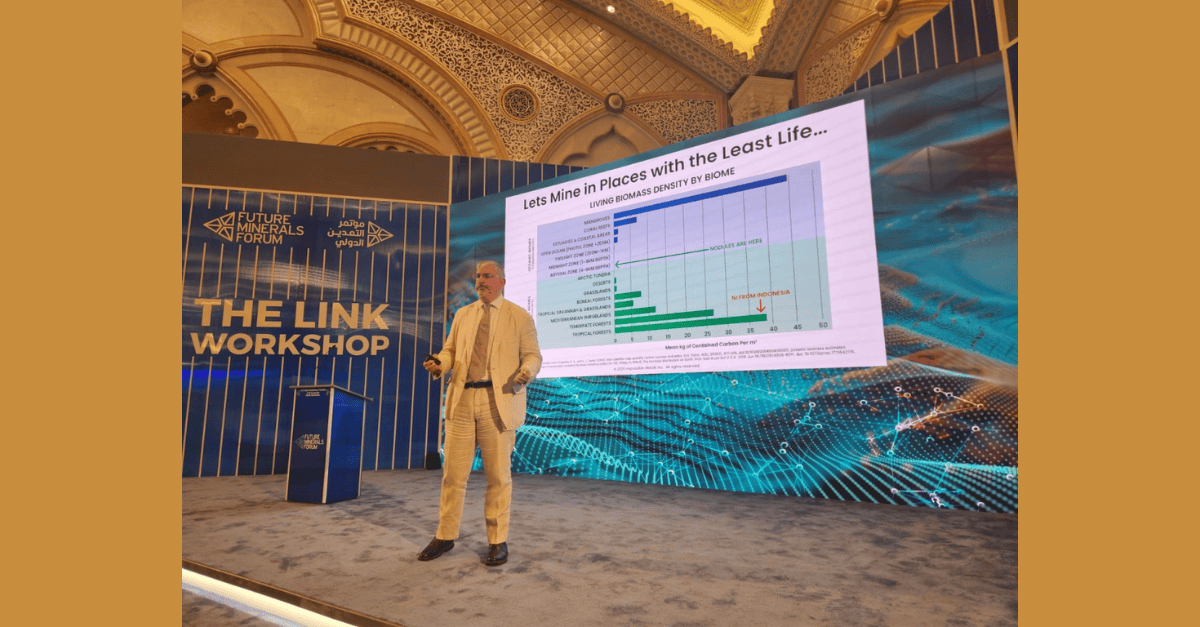
Impossible Metals CEO & Co-Founder Oliver Gunasekara spoke at the Future Minerals Forum in Riyadh, Saudi Arabia, sharing how next-generation technology is reshaping deep sea mining (DSM) and its role in securing global supplies of critical minerals. Oliver’s presentation slides are included below.
The accelerating demand for nickel, cobalt, copper, and manganese is drawing increasing attention to polymetallic nodules on the deep ocean floor. A central theme of the presentation was a simple principle: let’s mine in places with the least life. Polymetallic nodules are located in the abyssal zone (4–6 km depth), which the slides show has among the lowest living biomass density of any biome, far lower than coastal ecosystems or terrestrial environments where much of today’s land-based mining occurs.
Gunasekara highlighted the Clarion-Clipperton Zone (CCZ), a vast area of the Pacific Ocean located between Hawaii and Mexico, which contains an estimated $18.4 trillion in critical metals. Momentum around DSM is growing, including Bahrain’s move to become the 20th Sponsoring State, and the first Arab State, securing jurisdiction over a new 75,000-square-kilometer resource valued at approximately $0.25 trillion. This development positions the Gulf (GCC) region as a hub for emerging deep-sea mineral processing, advanced manufacturing, and maritime infrastructure.
Oliver’s presentation also emphasized the importance of choosing the right technology. Impossible Metals deploys autonomous, hovering, AI-controlled robots that selectively collect nodules while avoiding visible life and reducing sediment disturbance. By operating in the abyssal zone and using selective harvesting that leaves a large percentage of nodules undisturbed, the system is designed to reduce environmental impact while improving economic efficiency.
With China, the United States, and India heavily committed, commercial deep-sea mining is increasingly seen as inevitable later this decade. Impossible Metals is preparing to scale, with prototype and pilot operations planned for 2027, project financing in 2028, and commercial deployment of the Eureka III fleet by 2029.
Slides from the presentation are included below.
