
Modern life depends on critical materials.
They are becoming harder to source.
How we collect them matters.
The question is not whether we need these materials.
It’s how we collect them.
EUREKA Collection System
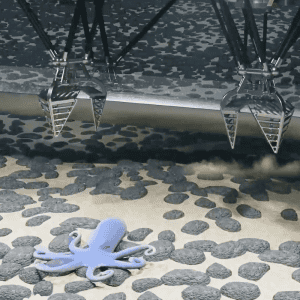
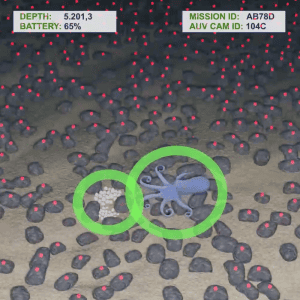
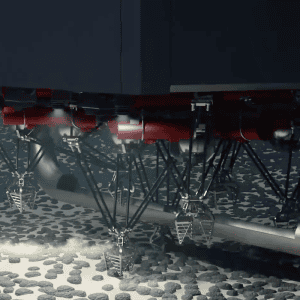
Impossible Metals uses AI-driven robotics to selectively identify and collect nodules — avoiding unnecessary disturbance.
See the system in operation
Built for precision. Designed for restraint.
Watch Full Walkthrough

No transition without metals
Nickel, cobalt, copper, and manganese are the backbone of every electric vehicle, grid battery, and wind turbine — and demand is accelerating far beyond what today’s mines can deliver. The International Energy Agency projects these needs will roughly quadruple by 2040 under a net-zero pathway.
The question is not whether we source them.
The question is how — and at what cost to people and planet.
At Impossible Metals, we believe the seabed can be part of that answer — carefully, selectively, and only when the evidence supports it.
Our approach is grounded in three principles:
- Data should lead. Independent life-cycle assessments consistently show that polymetallic nodules can carry a lower carbon, land-use, and biodiversity footprint than many terrestrial sources.
- Low impact is a design choice. Our robotic collection system selectively picks nodules, leaving the surrounding seafloor and ecosystems materially undisturbed.
- Science sets the boundary. We will only proceed where evidence demonstrates no material, long-lasting harm to marine environments or the ways people depend on the ocean.
There is real debate around seabed minerals — some of it grounded in science, some of it outdated, and much of it conflating very different technologies. We welcome that scrutiny.
Because the stakes are too high for shortcuts — and too important for assumptions.
What the evidence shows
Every electric vehicle, grid-scale battery, wind turbine, and modern defense system relies on metals like nickel, cobalt, copper, and manganese. These are not niche materials — they are the physical foundation of the energy transition and modern infrastructure.
The scale of demand is significant. The International Energy Agency and World Bank project that demand for these minerals will increase dramatically over the coming decades, far beyond what current land-based mining can supply alone.
The question is not whether we source these materials. The question is how — and at what cost to people and the environment.
Recycling is essential to a sustainable future, but it cannot meet near-term demand. Metals used in electric vehicles and energy systems can take decades to return to the supply chain, meaning most recycled material won’t be available until the 2050s or later.
The International Energy Agency estimates that recycling will supply only a small fraction of total demand by 2030 and 2040. The majority of required materials must still come from new sources.
New battery chemistries are also evolving, but they do not eliminate the need for key metals like nickel and cobalt, and typically take decades to scale from research to production. For the next several decades, the world will depend on responsibly sourced primary supply.
Much of the concern around deep sea mining is based on dredging systems that vacuum or scrape the seafloor indiscriminately. Our approach is fundamentally different.
Impossible Metals uses AI-guided robotic systems to selectively identify and pick up individual polymetallic nodules, leaving surrounding sediment and marine life largely undisturbed. There is no dredging, no cutting, and no midwater discharge plume.
“Low impact” is not a claim — it is a design principle built directly into how the system operates.
All resource extraction has impacts. The question is how those impacts compare — and how they are managed.
Polymetallic nodules are found on the abyssal plain at depths of 4,000 to 6,000 meters, where there is no sunlight and very little biomass. Most life in these environments is microscopic, and larger organisms are sparse.
Our system is designed to detect and avoid marine life, minimize sediment disturbance, and leave a significant portion of nodules undisturbed. Every project must also undergo a rigorous Environmental Impact Assessment before any mining can proceed, with independent scientific validation of impacts.
Today, much of the world’s nickel is mined in rainforests, and a large share of cobalt comes from regions associated with deforestation, pollution, and human rights concerns, including child labor.
Land-based mining often requires clearing ecosystems, displacing communities, and generating significant carbon emissions. These impacts are direct and long-lasting.
Seabed nodule collection occurs in remote, uninhabited areas of the ocean floor, with no need for blasting, tunneling, or deforestation. When done selectively and responsibly, it has the potential to be the lowest-impact source of critical minerals available.
Explore by Perspective
Measured impact
We approach environmental responsibility with rigor and transparency, focused on measurable outcomes rather than claims.
Reduction vs alternatives
Our selective approach is designed to reduce environmental disturbance compared to conventional extraction methods.
Ongoing research
We collaborate with research institutions to continuously study and understand deep-ocean ecosystems.
Transparency
We publish our environmental monitoring data and methodology for independent review.
