
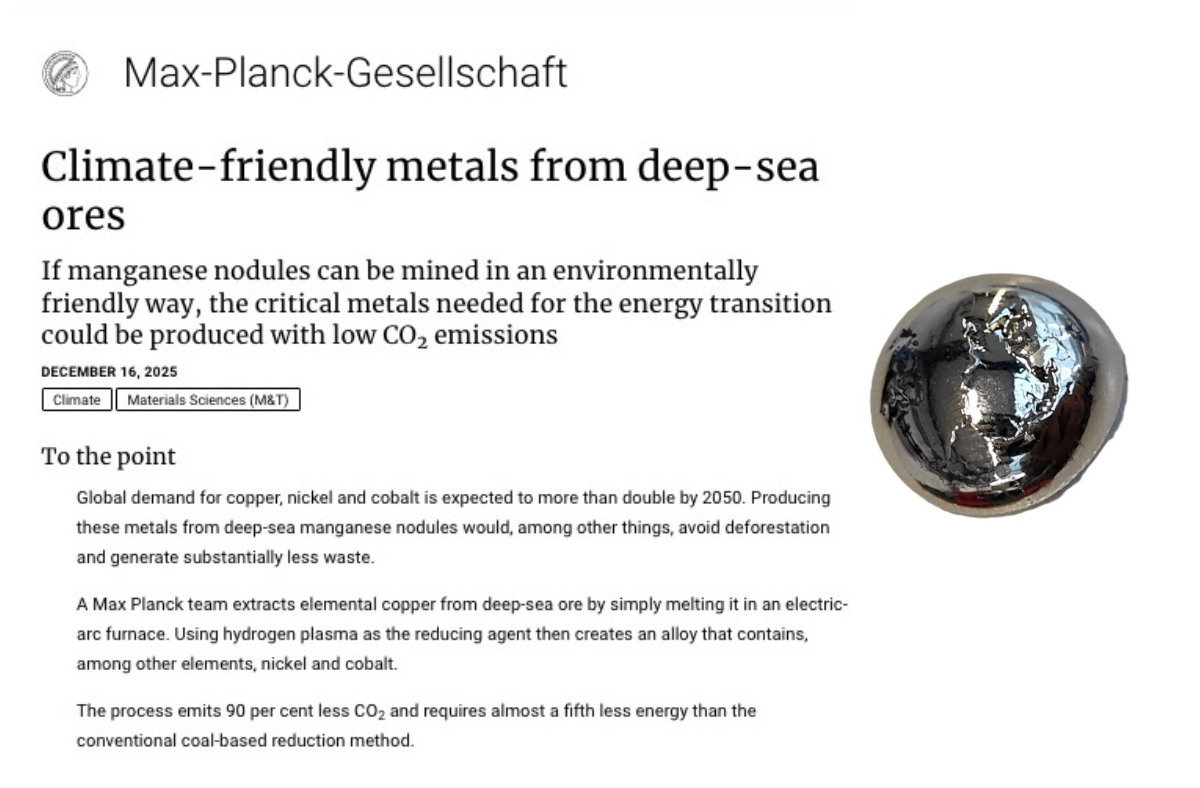
This report discusses research on the use of deep sea manganese (polymetallic) nodules as a source of critical metals such as copper, nickel, and cobalt—materials essential for the energy transition—highlighting that demand for these metals is projected to more than double by 2050. A team at the Max Planck Institute for Sustainable Materials has developed a low-carbon extraction method that uses hydrogen plasma in an electric-arc furnace to melt and reduce these nodules, producing an alloy with significantly lower CO₂ emissions and lower energy use than conventional coal-based processes. If deep-sea mining and this processing are carried out responsibly, it could avoid deforestation, reduce waste, and lessen some social harms associated with traditional land mining.
Read the report here.
